
How 4D BIM/Construction Sequencing Helps Contractors Win Competitive Tenders
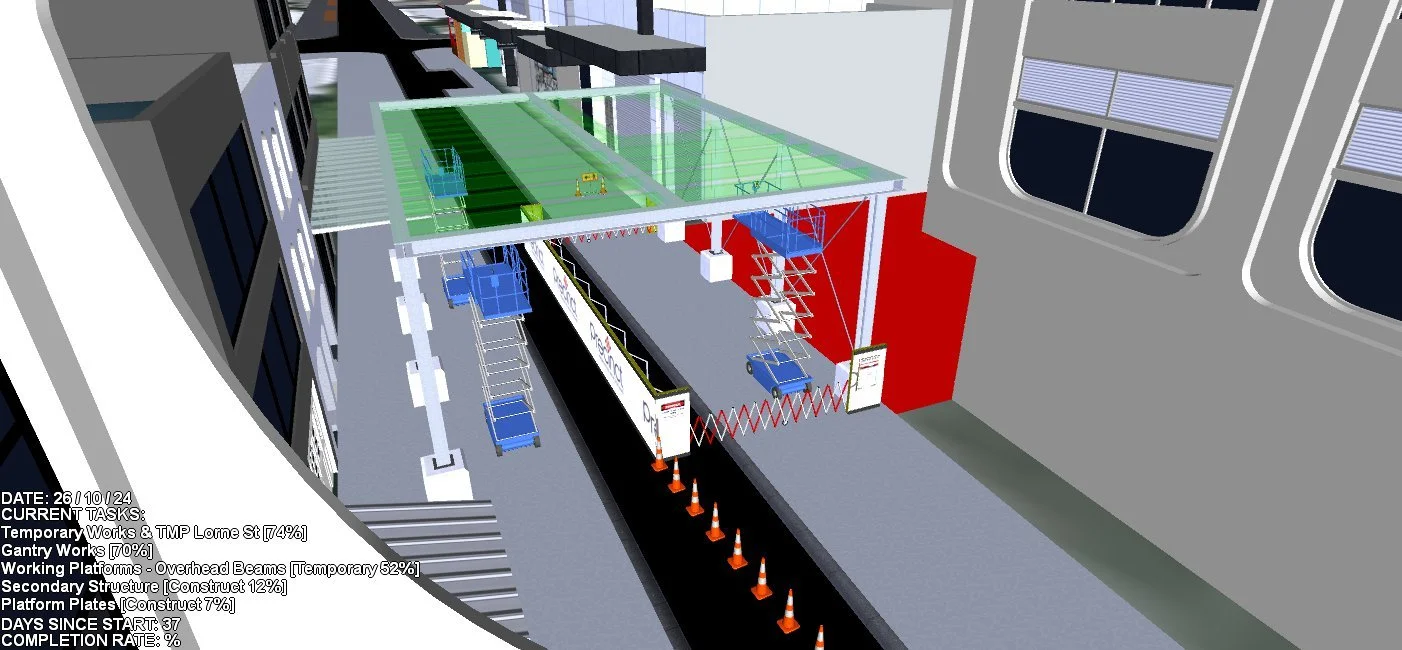
For contractors competing in New Zealand's increasingly demanding tender environment, price alone is no longer the differentiator it once was. Across both central and local government procurement, methodology, delivery confidence, and demonstrable risk management carry real weighting; sometimes more than the bottom line.
At Vaai Ltd, our 3D flyovers and 4D sequence animations turn complex construction programmes into compelling visual narratives that help contractors make the case for why they are the right team for the job.
More Than Linking a Program to a Model
When most people think of 4D BIM, they imagine a Gantt chart plugged into a 3D model, with bars driving geometry on and off over time. In practice, that description barely scratches the surface of what useful 4D sequencing actually requires.
For us, the starting point is almost always a rebuild. The programme that comes out of a contractor's estimating or planning software is functional for their internal purposes — it tracks activities, durations, and dependencies. But it is rarely structured to tell a story, and in a tender context, storytelling is everything. We extract the underlying logic from that programme and reconstruct it around the moments that matter most to the evaluating authority.
What does that mean in practice? It means isolating and animating the specific elements that make a contractor's method unique. Dedicated traffic management configurations, stop-go arrangements at constrained intersections, monitored key access routes, separated loading zones — these are not footnotes in a submission. To a council or principal assessing competing proposals, they are the evidence that a contractor has genuinely thought through how they will manage the real-world complexity of a live environment.
Showing that evidence visually, rather than asking an evaluator to interpret it from written text and static drawings, is a significant advantage.
Aligning Visuals to Non-Priced Attributes
Government procurement in New Zealand has evolved considerably. Many agencies now structure their evaluation criteria so that a meaningful proportion of the overall score is allocated to non-priced attributes — questions about methodology, programme confidence, safety management, community impact, and quality of delivery. In some cases, the weighting on how a contract will be delivered rivals or exceeds the weighting on cost.
This is not unlike the decision a homeowner makes when selecting a building contractor. Price matters, but it rarely decides the outcome on its own, particularly on projects where home owners seek a higher quality outcome. Clients want to understand who they are handing a significant project to, what their approach looks like, how quickly and reliably they will deliver, and what the experience of having them on site will actually be.
Our approach to stage or sequence these narratives, is built around this reality. When we take on a project, we read the non-priced attribute questions closely and map the animation directly to what those questions are probing. If an evaluator wants to understand how a contractor will maintain pedestrian safety through a particular phase, we build that phase out in detail. If the question is about programme certainty and the contractor's ability to meet a critical milestone, we show the sequencing logic that underpins that commitment. The visual becomes a direct answer to the question — not a general overview of the project, but targeted evidence for the specific concerns an authority has already told you they are going to assess.
Civil and Horizontal Works: Managing the Public Interface
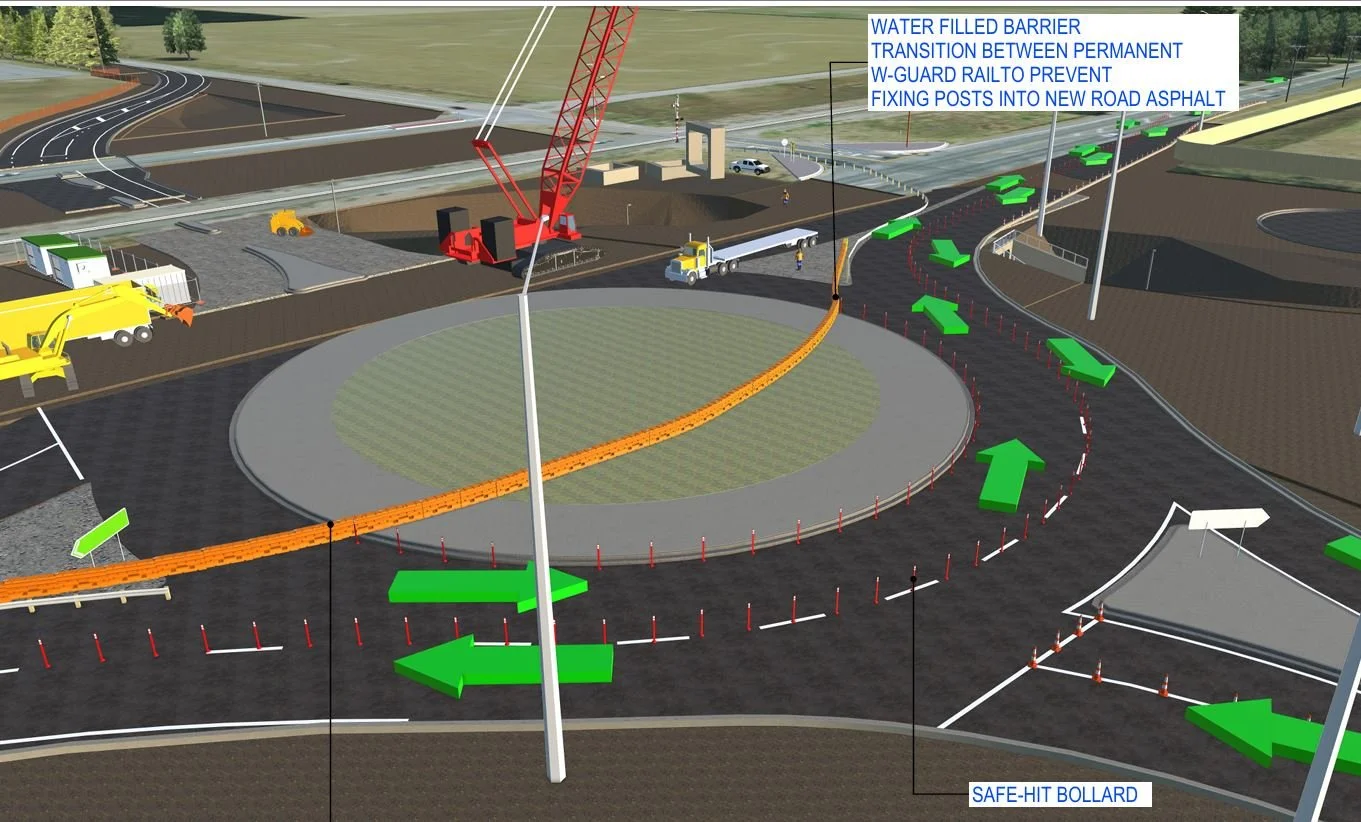
For our civil and horizontal infrastructure clients, the tender challenges are predominantly about what happens at the boundary between the worksite and the public. Road reconstruction, utility upgrades, pedestrian network modifications, and urban renewal projects all involve a fundamental tension: the work has to get done, and the world around the site has to keep functioning.
The questions that arise in this space are rarely simple. How do you maintain safe pedestrian movement through a section of footpath that is being progressively removed and reinstated? How do you protect cyclists sharing a temporarily narrowed carriageway? What happens when a construction crossing is established adjacent to a school or a healthcare facility?
We have worked on projects where these questions carry genuine life-safety stakes. One example that illustrates the complexity well is a worksite located near a psychiatric unit. Construction activity in close proximity to a hospital ward that houses patients with acute mental health conditions creates a specific risk profile that a generic traffic management plan does not adequately address. Patients may exit the facility unexpectedly. They may not respond predictably to conventional pedestrian controls. A crossing over an active haul route in that environment requires layers of protection and supervision that need to be explicitly designed, communicated to the evaluating authority, and demonstrated through the submission.
That kind of scenario is exactly where our services in 3D staging and 4D sequencing earn its value. Written text describing a multi-layered pedestrian management system is difficult to evaluate. A 3D animation showing precisely how that system operates through each phase of the work, with the spatial relationships clearly visible, gives an evaluator genuine confidence that the contractor has understood the problem and designed a solution.
Commercial and Vertical Works: Compressed Complexity
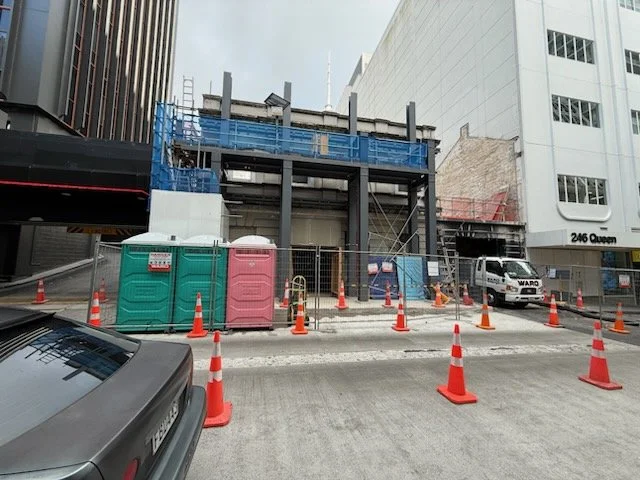
Vertical commercial construction presents a different set of challenges, but they share one defining characteristic with horizontal civil work: the consequences of getting sequencing decisions wrong are serious, and the people most likely to be affected are often members of the public or adjacent stakeholders with no direct role in the project.
Where civil work tends to distribute its complexity across a long linear corridor, commercial building construction compresses everything into a very tight footprint that is typically down to the boundary line. Tower cranes, temporary works, logistics, welfare facilities, exclusion zones, and perimeter management all have to coexist on sites that are frequently bounded by active footpaths, critical infrastructure (traffic signals, manholes, fibre internet lines), operating businesses, and occupied buildings.
The overhead risk profile of a commercial build is one of the areas where visual communication is most critical. Tower crane height, radius, and swing arc are straightforward to describe in words, but genuinely difficult to convey in a way that gives a principal confidence. Where exactly does the slewing arc extend? Does it pass over a public road? Does it overlap with a neighboring building or another crane on an adjacent site? Is the machine set to weathervane at the end of each shift, and if so, what does that mean for the exclusion zone in different wind conditions? A well-constructed 3D model with crane geometry accurately placed and rigged answers these questions in a single view.
Beyond overhead risk and fall protection, vertical builds require careful sequencing of logistics in a space where there is frequently no room for improvisation. Where will materials be received? Where does the site compound sit, and how does that position change as the building rises and ground floor space is progressively lost to the structure? When is the tower crane removed, and what does that transition to alternative lifting arrangements look like? These are questions that experienced project managers carry in their heads, but that need to be externalized and communicated clearly in a tender submission if a contractor is to demonstrate delivery credibility.
The Value of Practical Experience
There is something that no amount of software proficiency can fully replicate, and that is the intuition that comes from having actually done the work.
Our background is not limited to design and visualisation. Our team has worked on New Zealand commercial construction sites as carpentry tradespeople, engineering technicians and supervisors. We have held the roles that our models represent. We know what a well-run crane pick looks like, and we know what a poorly positioned site office costs you when the structure is four storeys up and every decision requires a trip back down. We have worked in the compressed, high-pressure environment of a commercial build and we have managed the daily reality of keeping a civil worksite safe and productive while the public moves through it.
That experience shapes everything we produce. When we build a visualization set of graphics or animation, we are not theorizing about how a construction process might unfold. We are drawing on a genuine understanding of how it does, and using that understanding to create graphical content that reflects real-world decision-making rather than lines of program duration.
For contractors preparing competitive tenders, that distinction matters. Evaluators who have delivered projects themselves will recognize the difference between a sequence that has been built by someone who has thought through methodology, and someone that has used a generic policy based format. The credibility of the submission rests, in part, on the credibility of the visualisation, and that credibility comes from knowledge of actively constructing, not just from capability with software.
Why Visual Communication Is Not Optional
Construction tenders have always required written methodology statements, program submissions, and risk registers. These documents remain important, but they are increasingly insufficient on their own in a market where visual literacy is high and expectations around submission quality are rising.
The challenge with complex construction methodology is that it is genuinely difficult to hold in the mind from a written description alone. A written paragraph explaining a two-phase traffic management arrangement at a signalized intersection can be accurate and detailed without being persuasive, because the reader has to do too much cognitive work to build a picture from the words. An animation of the same arrangement, showing vehicle flows driven by ADT counts, pedestrian path active and inactive, and the physical configuration of each phase in sequence, communicates the same information in a fraction of the time and leaves the evaluator with a clear and lasting impression.
For government and council procurement specifically, where evaluation panels may be assessing multiple competing submissions over a short period, the quality of a submission's visual communication can determine whether a contractor's methodology is genuinely understood or simply noted.
At Vaai Ltd, 4D BIM and construction sequencing is not a product we apply uniformly. It is a process we tailor to the specific tender, the specific evaluation criteria, and the specific challenges a project presents. The result is a submission tool that does what written text partially can: show, compellingly and clearly, why a contractor is the right choice.
