
How to Design & Build a Granny Flat in New Zealand
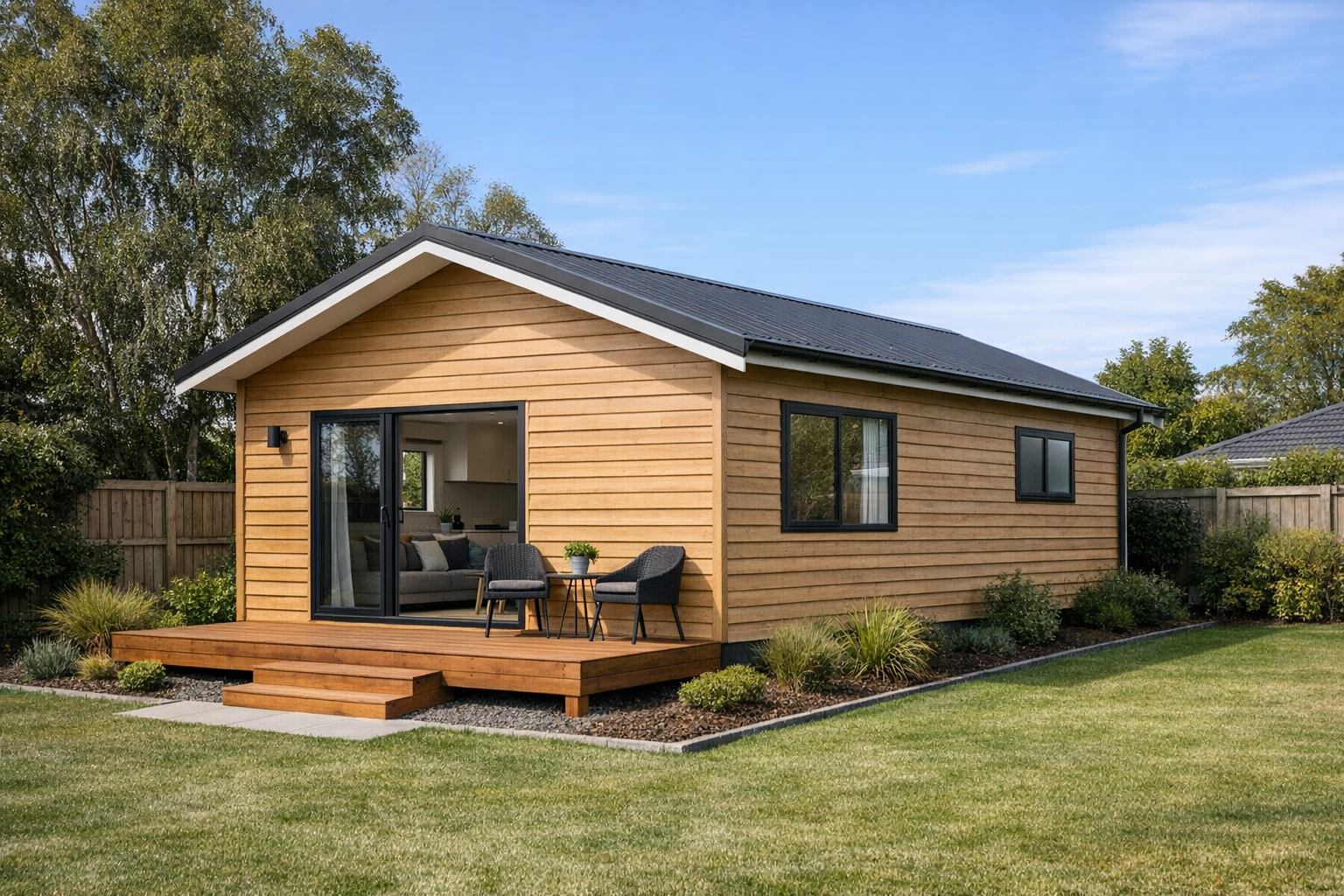
Artists Impression - Typical NZ Granny Flat
A complete guide to the 2026 MBIE exemption process, from initial conversation to completed build.
New Zealand's granny flat rules changed significantly in late 2025. The Government passed the Building and Construction (Small Standalone Dwellings) Amendment Bill in October 2025, and the regulations bringing the building consent exemption into force came into effect in early 2026. Combined with the removal of resource consent requirements for eligible granny flats at the end of 2025, this is the most significant simplification of residential building rules in decades.
The short version: if your granny flat is up to 70 square meters, meets a simple design standard, and is designed by an LBP Designer, and built by an LBP Carpenter, you no longer need a building consent or resource consent. The process is now governed by MBIE's published guidance, and has opened up accessible/easier pathways for home owners to leverage existing properties, without the hurdles of a typical consent process.
No consent' does not mean 'no process.' There are still clear legal requirements under Schedule 1A of the Building Act 2004, and getting them right is what separates a compliant, insurable, mortgageable dwelling from an expensive problem. That's where we comes in.
This guide walks you through the process, from your first conversation with us through to a completed, fully compliant granny flat on your property.
What the New Rules Actually Mean
Under the exemption, a granny flat up to 70m² can be built without a building consent or resource consent, provided 4x conditions are met:
Simple design — the dwelling must meet MBIE's defined 'simple design' criteria (single-storey, lightweight materials such as timber or steel framing, straightforward geometry)
Building Code compliance — the build must still fully comply with the New Zealand Building Code across all clauses: structure, fire, moisture, energy efficiency, services
Licensed professionals — all restricted building work must be carried out or directly supervised by a Licensed Building Practitioner (LBP), and licensed trades (registered plumber/drainlayer, registered electrician) must complete and sign off their work
Council notification — the homeowner must notify the local council before construction starts and again on completion, using the MBIE forms
The Building Code has not been relaxed. Quality and safety standards are identical to a consented build, what's changed is the process for demonstrating compliance. Instead of a council checking your drawings before you start, and inspecting your build as it progresses, the onus sits with you and your licensed construction team to ensure the build is compliant, and to ensure the process is documented, recorded and managed properly. For a 70m2 build with multiple trades, this is still a fairly sizeable task and means good processes & systems will determine the outcome of the build.
'No consent' doesn't mean 'no accountability.' It means the responsibility for compliance sits with the homeowner and the licensed professionals they engage, not the council. Choosing the right team is more important than ever.
The Project Information Memorandum (PIM)
Even without a building consent, you must apply for and receive a Project Information Memorandum (PIM) from your local council before starting construction. The PIM is council's way of telling you about site-specific matters, flood risk, contaminated land, services, hazards that affect your project.
MBIE provides the forms: Form 2AA (your application) and Form 2AAB (council's issued PIM). This is a mandatory first step, and is unlawful start construction without it.
Councils will also charge development contributions when issuing the PIM, so factor this into your budget early. Its also worthwhile to note that there is likely to be an increase in your annual rates from the addition of a new dwelling onto your property, how much that is will be dependent on how large your new dwelling is and how much resource it takes from the utlities network i.e. power, water & waste water.
What Doesn't Qualify for the Exemption
The exemption is specifically for simple, single-storey standalone dwellings.
The following do not qualify:
Two-storey or split-level designs
Dwellings over 70m² gross floor area
Dwellings using heavy or complex structural systems outside MBIE's definition of lightweight construction
Conversions of existing structures (garages, sleepouts) — these may still need consent
Builds in certain high-risk zones where district plan rules still apply
If your project falls outside the exemption, we'll tell you upfront and manage the full consent process for you, that capability still sits within our scope of service.
Step 1: Site Assessment & Feasibility
Every project starts the same way: a site visit and a straight conversation. When you reach out to us, we come to your property to assess what's possible and whether the no-consent pathway is suitable for your project/site.
We're checking:
Does the site meet the resource consent exemption criteria under the National Environmental Standards for Detached Minor Residential Units (NES-DMRU)?
Are there site-specific constraints: slope, setbacks, flood overlay, easements, lift limitations, parking that will shape the design?
Does your preferred floor area sit within the 70m² threshold
What are the servicing options for power, water, and wastewater?
What's your budget and realistic program for start to finish?
At this stage, we'll give you a clear recommendation: no-consent pathway, consented pathway, or a flag that something needs to be resolved first. No ambiguity.
Step 2: Developing a Simple Design
With feasibility confirmed, we move into design. Under the no-consent pathway, the design must meet MBIE's 'simple design' conditions, and we work within those parameters from day one alongside a Design LBP.
Vaai Ltd develops all designs in 3D using a range of BIM/CAD Software. This means:
You see a realistic visualization of the finished dwelling before a single piece of timber is cut.
We identify buildability issues; clash detection, structural coordination, weathertightness details, before they become costly variations on site.
The 3D model feeds directly into construction documentation, material schedules, and cost estimates helping give us confidence, what is modelled is a direct representation of what is built.
Our typical granny flat for the Wellington/Porirua/Kāpiti region is a single-storey, timber-framed structure designed specifically for the coastal exposure zone. Appropriate H-class treated timber, carefully detailed wall build-ups, and a weathertightness envelope specified to perform for decades.
Design documentation includes:
Floor plan, elevations, sections and sectional details as well as call outs and specifications
Site plan (required for PIM application and council notification)
Structural framing layout, coordinated with engineering input where required
Electrical and Drainage Plans as required if separate drawings are required for our specialist trades
Window, door, material and hardware schedules
Building Code compliance narrative
Virtual Reality Enabled 3D walkthrough and perspective renders
Step 3: PIM Application
Before any ground is broken, two things must happen under the MBIE process:
1. Apply for a PIM (Form 2AA)
We prepare and lodge the PIM application on your behalf to your local council — Porirua City, Wellington City, or Kāpiti Coast District Council depending on your location. The PIM draws out any site-specific risks or requirements council needs to flag before you build.
Council issues the PIM using Form 2AAB, and may provide additional site information via Form 2AAC. We review what comes back and factor it into the design and construction program provided there are delays.
2. Pre-Construction Notification
Once the PIM is issued and you're ready to proceed, the homeowner notifies council that construction is about to commence. Vaai Ltd handles this paperwork as part of our service, provided you need help navigating MBIE forms.
3. Development Contributions — Budget for These Early
When your PIM is issued, council will assess whether a development contribution is payable. Under the Building Act as amended, councils are specifically empowered to charge development contributions at the PIM stage for consent-exempt granny flats, it's a deliberate part of the new framework. The contribution must be paid within 20 working days of completing the build.
Development contributions exist because a new dwelling places additional demand on shared public infrastructure: roads, water supply, wastewater, stormwater, parks, and community facilities. These contributions help councils fund the cumulative cost of that growth.
The amount varies by council and by the size and location of your project. As a general guide based on current council schedules, urban properties typically attract development contributions in the range of $17,000–$30,000, while rural residential properties tend to sit in the $4,000–$7,000 range. Your specific council's schedule is the authoritative source to learn this from. We can flag this at feasibility stage so it's in your budget from day one
Development contributions are a typical underestimated costs in granny flat projects, treat it as a project cost and factor it in at the beginning.
4. Rates — Expect an Increase
Adding a granny flat to your property is a permanent improvement, and it will affect your annual rates bill. There are two mechanisms at play.
First, a new dwelling increases your property's capital value, which is the basis on which general rates are assessed. A higher capital value means a higher rates bill. How much higher will depend on the size of the dwelling, the quality of construction, and the current valuations in your area, but it's reasonable to expect a meaningful increase once the new dwelling is captured in your next valuation cycle.
Second, if the granny flat connects to council-provided infrastructure services; water supply, wastewater, stormwater, you may become liable for additional targeted rates associated with those services. These are separate from general rates and are charged based on your connection to and use of council infrastructure. A second dwelling drawing on water and wastewater services will typically trigger additional targeted rate assessments.
Neither of these increases is a reason not to build a well-located granny flat generating rental income is a strategy for covering these added costs. However, they are ongoing costs that belong in any grounded financial assessment of the project.
Step 4: Pricing & Contract
With the PIM received and the design finalised by an LBP Designer, we produce a detailed construction CPE which includes labor, materials our value add to the project as well as a building contract.
Our pricing is transparent and itemised; foundations, framing, roofing, cladding, joinery, insulation, services, fit-out. Typical all-up costs for a quality 1–2 bedroom, 60–70m² granny flat in the Wellington/Porirua region currently sit between $180,000 and $280,000 depending on specification and site complexity. We provide a project-specific number, not a rule-of-thumb.
Contracts are structured with payment milestones tied to construction progress. The no-consent pathway doesn't eliminate the need for a proper written contract — if anything, it makes one more important, since consumer protection obligations under the Building Act still apply.
Consumer protections for residential building work under the Building Act apply to no-consent granny flats just as they do to any other residential build. Written contracts, implied warranties, and defect liability provisions are all in play.
Step 5: Construction
This is where the design becomes reality. As a Licensed Building Practitioner (LBP AoP1), Jay leads the build directly. Under the no-consent exemption, all restricted building work must be carried out or directly supervised by an LBP — this is a legal requirement, not a marketing point. You are not handed off to an unsupervised crew.
Construction follows a methodical sequence:
Site set-up, access, and subfloor/foundation work
Timber framing: walls, roof structure
Roofing and weathertightness wrap (Cavity Based)
Windows and external doors
External cladding specified for your wind and exposure zone
Services rough-in and fit-off coordinated with a registered plumber/drainlayer and registered electrician
Internal fit-out: insulation, lining, flooring, joinery & shower installation
Painting, hardware, final service connections, final finishes
Under the no-consent pathway, there are no council inspections during construction. This increases the importance of on-site quality control, accurate documentation, and using professionals who know the Building Code.
Any variations to the design during construction are documented and assessed against the MBIE simple design conditions. If a change would take the project outside the exemption criteria, we flag it immediately.
Note: Service Connections Are Not Exempt
One of the most common misconceptions about the no-consent pathway is that it applies to the entire project — structure, fit-out, plumbing, drainage, and electrical all included, It does not.
The building consent exemption covers the building work itself. It does not exempt the connections to network utilities, and it does not change the licensing requirements for the trades carrying out that work.
This matters, and it's worth being clear about what it means for your project.
Wastewater & Stormwater Drainage
Connecting a new dwelling to the wastewater and stormwater network requires separate approval from your local council or network utility operator, regardless of whether the building itself is consent-exempt. In practice, this means a drainage consent or equivalent approval from your council's infrastructure or wastewater team, separate from the building consent exemption process.
The drainage design must demonstrate how the new dwelling's wastewater will be discharged. Typically via connection to the existing house drain and on to the public sewer, and how stormwater will be managed on site. For many Porirua and Wellington properties, there are existing constraints on sewer capacity and stormwater discharge points that need to be checked before you commit to a design.
Drainage consent is often the longest-lead item on a no-consent granny flat project. We factor it into the programme from day one and coordinate directly with our registered plumber/drainlayer to get the design right before we break ground.
Mains Water Connection
Similarly, connecting to the mains water supply requires approval from the network utility operator in Porirua and Wellington, that's Watercare or Wellington Water depending on your location. This is a separate process from the building consent exemption and typically involves a connection application, infrastructure charges, and a physical connection by the network operator or an authorised contractor.
The Schedule 1A conditions require that water supply connections for consent-exempt granny flats are straightforward and tie into existing services. If your property's existing water supply infrastructure can't readily support a second dwelling. Example; if the existing toby or meter is undersized, this needs to be resolved as part of the design phase.
Electrical Connection
The building consent exemption does not affect the requirements of the Electricity Act 1992. All electrical work in the granny flat internal wiring, switchboard, and connection to the existing supply — must be carried out by a registered electrical worker. They must issue a Certificate of Compliance (CoC) on completion, which forms part of your post-construction handover package to council.
Connecting the granny flat to your property's existing electrical supply will require an assessment of whether the main switchboard and consumer installation can support the additional load. In many cases, a switchboard upgrade or new sub-board will be required. Your electrician will advise on this during design, and we will coordinate this as part of the wider services design.
What This Means in Practice
The services connections — drainage, water, and electrical — add a layer of coordination and approval that runs in parallel with the building work. None of it is particularly difficult when managed properly, but it requires early engagement with the right trades and the right network operators. Leaving it until the building is framed up creates delays and, in some cases, expensive rework.
The building consent exemption makes the building side of a granny flat faster. It doesn't shortcut the services. Budget for drainage consent, water connection, and electrical compliance from the start, and use a team that manages this coordination for you.
Step 6: Records of Work & Post-Construction Notification
Completion under the no-consent pathway is governed by MBIE's records of work requirements. This is where documentation matters a great deal to both homeowner and builder.
Records of Work
Each licensed professional involved in restricted building work must complete a Record of Work on completion. Vaai Ltd as LBP completes our record covering the structural and weathertightness work. Our plumber/drainlayer completes theirs using the MBIE-specified form for sanitary plumbing and drainlaying on non-consented standalone dwellings. Our electrician completes a Certificate of Compliance. These records are legal documents. They confirm the work was carried out by a licensed professional and meets the Building Code.
Post-Construction Council Notification
Within 20 working days of completion, the homeowner lodges plans and all records of work with council. We prepare this complete handover package; drawings, records, producer statements, and any other required documentation on your behalf.
At handover, you receive:
• All records of work from the LBP and licensed trades
• As-built drawings
• Producer statements and material warranties
• A briefing on operating and maintaining your new dwelling
There is no Code Compliance Certificate (CCC) under the no-consent pathway — the records of work are your equivalent. Keep them safe. They will matter when you sell or refinance.
How Long Does It Take?
One of the real advantages of the no-consent pathway is program. Without a consent queue, the pre-construction phase is primarily driven by PIM processing times, drainage consent and design completion. Typically 8–12 weeks rather than 4–6 months.
From first conversation to completed granny flat, a straightforward project on a ready site can move through in as little as 5–7 months. We'll give you a project-specific program estimate at feasibility stage and work hard to keep it.
Why Vaai Ltd
The no-consent pathway shifts accountability from council to the licensed professionals you engage.
That makes choosing the right team the single most important decision in your project.
Vaai Ltd brings:
LBP AoP1, legally qualified to carry out and supervise restricted building work under the exemption
Masters Degree Accredited Construction Project Management Professionals
15-20 years of hands-on experience locally across residential and commercial sites in Wellington and Porirua
BIM/CAD and 3D modelling built into every project — so the design is buildable, coordinated, and documented before we start
Integrated delivery — design, documentation, PIM management, construction, and handover records all under one roof
Local knowledge — Wellington/Porirua/Kāpiti climate exposure, council processes, and supply chain
We're not a volume operator selling a kitset. We're a lean, technically-led design-build practice that manages your project from first call to final record of work who stand behind the quality of what we build.
If you're thinking about a granny flat and want a straight conversation about what's possible under the new rules, reach out.
First consultation is on us.
Get in Touch
Visit us at vaai-ltd.co.nz or contact us directly to arrange a site visit.
We work with homeowners across Wellington, Porirua, Plimmerton, and the Kāpiti Coast.
Further reading: MBIE Granny Flats Exemption Guidance — building.govt.nz
www.vaai-ltd.co.nz or email us @info@vaai-ltd.co.nz
