What is 4D BIM in Construction?
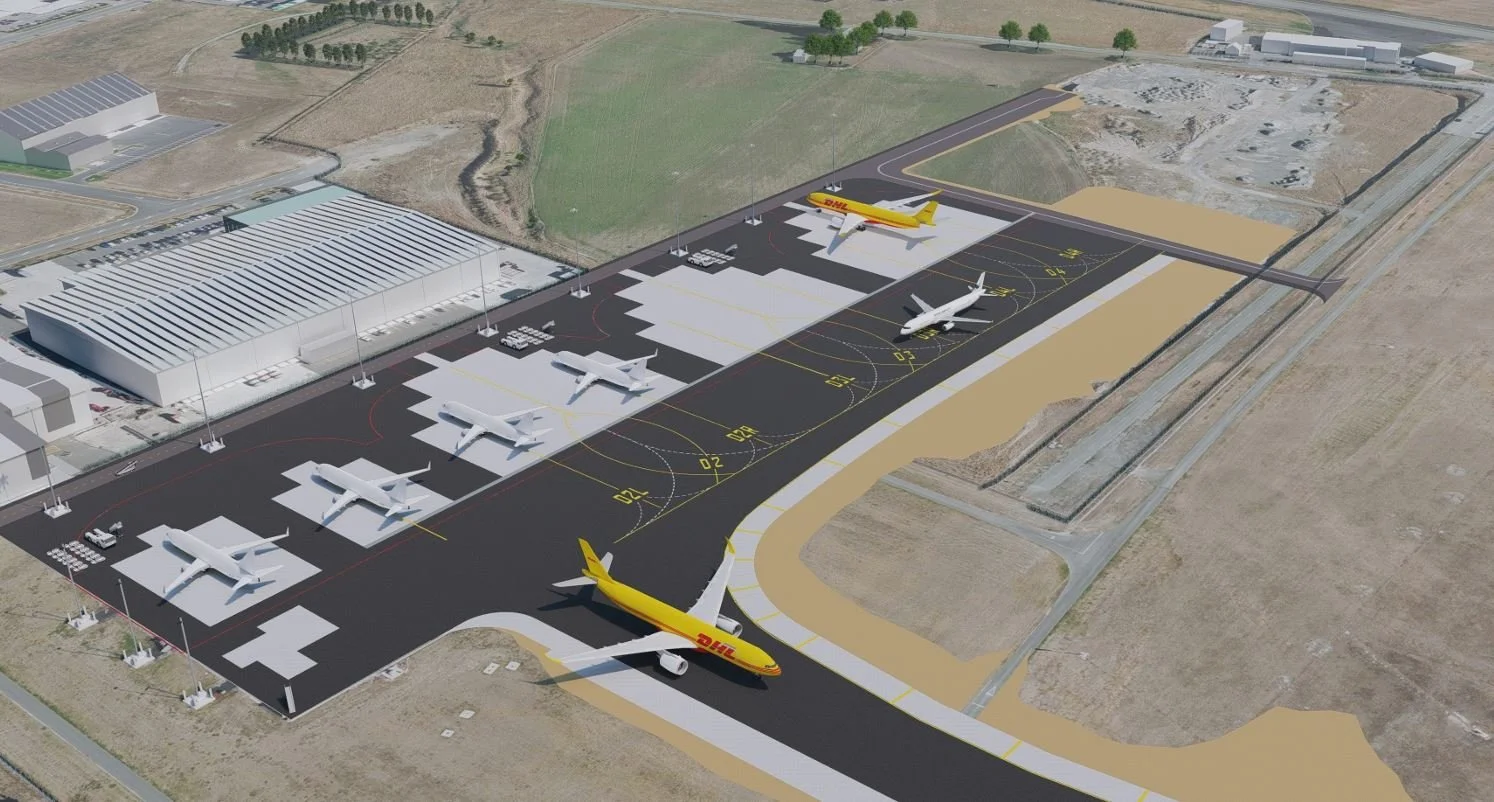
The Gantt chart has been the backbone of construction planning for well over a decade, and for good reason — it works. However as projects grow in complexity, the gap between what a schedule communicates and what a project team actually understands is widening fast - this gap is where 4D BIM lives.
Where Does 4D Sit in BIM?
Before getting into what 4D animation actually does on a project, it helps to understand where it comes from.
BIM — Building Information Modelling — is a process for creating and managing information across the full lifecycle of a built asset.
Internationally, it is defined and governed by the ISO 19650 series of standards, which forms the basis of the UK BIM Framework and has since been adopted globally, including as a reference point for the New Zealand construction sector and associated BIM/CAD groups.
Within that framework, BIM is understood as operating across a spectrum of dimensions, each one adding a layer of intelligence to the base 3D model:
3D — geometry and spatial coordination (the model itself)
4D — time and construction sequencing (the model linked to a programme schedule)
5D — cost and quantity (the model linked to a bill of quantities or cost plan)
6D — sustainability and lifecycle performance data
2D - refers to traditional flat CAD drawings (plans, sections, elevations) produced in tools such as AutoCAD.
It predates BIM as a concept and sits outside the dimension framework in ISO19650. The reason the spectrum starts at 3D is because BIM by definition requires a model as a data-rich 3D object as its foundation.
As NBS describes it, 4D BIM is the addition of scheduling information to model construction sequences, adding a dimension of time that allows the project team to better visualize how construction will be sequenced.
That's the formal definition. In practice, it means something more tangible: you take the program schedule your nominated planner has built, and you watch your project get constructed — task by task, week by week before a single profile has been driven into the ground.
What Is a 4D Construction Animation?
At its core , 4D Construction Animation is straightforward:
Take a project's program schedule, the task-by-task list with start and finish dates developed by your planner or project engineer (sometimes both) and attach it directly to corresponding 3D model elements. Some models will have intelligence data attached and some will not, these determine if the model is truly BIM or simply just a 3D model. Each model type is suited to the nature of the project requirements.
Tools like Navisworks and Synchro allow you to link individual tasks to their corresponding 3D components. That might be a concrete slab, a structural steel frame, a precast wall panel, or even a piece of construction equipment such as a tower crane, an excavator, a concrete pump.
Once those links are established, you can run a simulation that plays out the entire construction sequence in real time, from breaking ground to handover.
The result is a construction program you can watch.
The Problem With Gantt Charts at Scale
A Gantt chart is a precision instrument. In the right hands, a seasoned project engineer, project manager, or an experienced planner — it tells a complete story. But on a multi-million dollar project with hundreds and sometimes thousands of interlinked tasks, that story is written in a language that few people can read fluently let alone identify risk.
Handing a large program schedule to an individual means: parsing dozens of line items/bars, cross-reference dependencies, manually track float, identify the critical path, and mentally simulate the construction sequence with the design drawings.
What Changes When You Go Visual
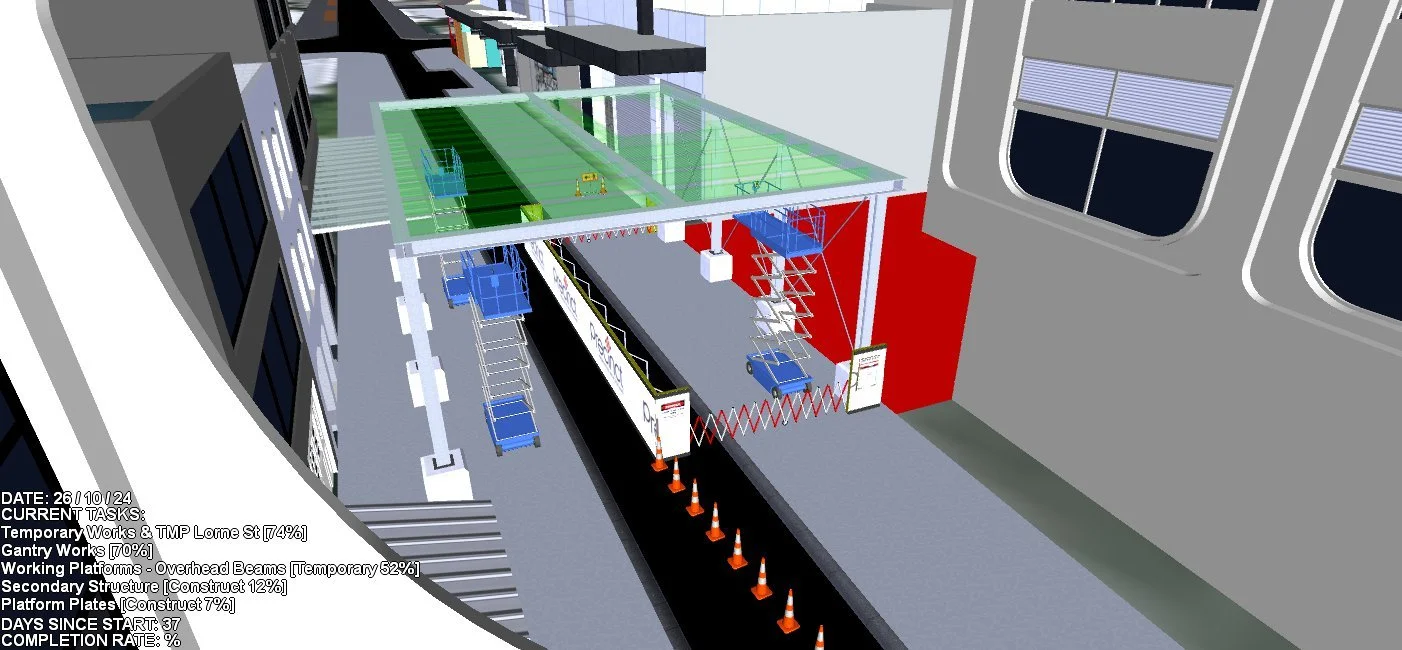
4D Construction Animation of Temporary Works to Construct an Temporary Loading Zone
When you simulate a program as a 4D animation, something shifts in the room.
The real change is that the storyline of the construction process becomes streamlined and ordered. Cross-referencing a Gantt chart against design drawings is a time-consuming exercise, you can spend days going line by line through a program, and half that time is spent clarifying what a task actually relates to in the physical design.
The back and forth can be exhaustive depending on who is in the room and what is the nature of the content being presented, it eats into the time available for the conversations that actually matter.
A 4D animation, alongside well-prepared staging diagrams — organizes the constructors concepts into a cohesive, structured presentation. It gives content and presentations a backbone. Rather than chasing answers across a spreadsheets, bar charts and a drawing set, the project team can move/flag issues efficiently through the full agenda: logic, safety, program certainty, critical path, stakeholder assurances, and when linked to cost data through 5D BIM, budget tracking and cost control per milestone or per stage.
More ground gets covered, decisions get made faster, and the right people are talking about the right content that is progressive to the projects continuity.
Questions start to pop-up quicker:
Why is the crane on site for four days when there's no lifting scheduled, can we reduce that line and reschedule for the week after?
Can we achieve that slab pour with the three 20T diggers already doing the demo using chain attachments and reschedule the mobile off a few days earlier and bring him back the week after?
Sequence of structural installation is progressing in zone b, however our pedestrian route is under the slew radius, adjust that to setup to a no-go zone, or place a spotter.
Are residents still able to access their property with the road reserve under construction? what will you have in place to ensure access is retained safely when you have the road closure in place in stage 3?
These are critical program and safety observations, and in a 4D simulation, they surface in minutes giving confidence to the project team that we are assessing risk from as many angles as possible to identify major program constraints before works begin. While at the same time providing a resource to stakeholders to voice their concerns using a visual medium that everyone can understand.
Construction sequencing has direct safety implications. The order in which work happens determines what hazards exist at any given time: working at height, crane exclusion zones, concurrent trades in tight spaces, traffic management staging. A 4D simulation makes those interactions visible. Design for safety becomes something you can see and interrogate.
Program certainty works the same way. When you can watch the build sequence play out, clashes and inefficiencies that might not show up until week six on site become obvious in the planning phase, where they costs are minimal.
Tender Advantage
This is where 4D BIM becomes a genuine commercial differentiator. We provide both a 4D animation, typically a YouTube link embedded in the submission, as part of the tender response if the submission is digital.
That "everyone else" matters more than many contractors realize. Most major projects involve non-construction stakeholders: clients, investors, local authorities, public consultation groups. These are people who have a legitimate interest in how and when the work gets done, but no framework for reading a P6 schedule. A 4D animation bridges that gap entirely.
You're no longer just demonstrating that you have a program. You're demonstrating that you understand the program, that you've thought through the sequence, and that you can communicate it clearly to non-construction stakeholders.
Program Schedules
It needs to be said: 4D BIM is not a replacement for traditional program scheduling. The Gantt chart isn't going anywhere. The critical path method isn't going anywhere.
What 4D does is provide those tools with a communication layer they've always needed. The intelligence already exists in the schedule. The 4D animation just makes it readable by project managers under pressure, by clients with no construction backgrounds, by safety teams evaluating sequencing risk, and by the broader project team who need to understand what's happening and why.
Every major Tier 1 contractor in New Zealand and internationally is either already this space, or is moving in this direction. The projects are bigger, the stakeholder groups are broader, and the cost of miscommunication is higher than it's ever been.
Vaai Ltd is a Wellington-based design-build practice specializing in integrated delivery — combining technical drafting, BIM, construction sequencing, and on-site execution. If you're working on a project that would benefit from 4D construction visualization,
Get in touch.